
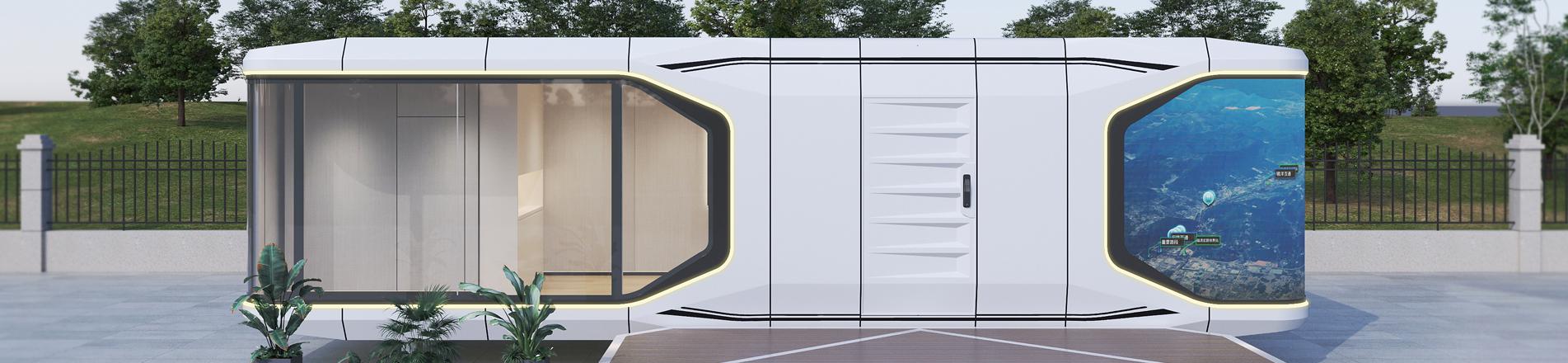
A container house is built in four blocks of work — steel incoming and cutting, forming and joining, surface treatment and finishing, then inspection and dispatch — with a quality checkpoint at both ends and in the middle of the sequence. Wanbang runs the whole sequence in its own factories rather than outsourcing stages, and quality control sits at three fixed points in the line: incoming material inspection, in-process inspection, and final inspection before the units are packed.
This article goes through what actually happens on the production line, what each machine does, and what is checked before a unit is allowed into the shipping container.
The production flow runs in a fixed order, and every unit follows the same route regardless of whether it is a flat-pack container house, a quick-assembly unit or a folding container. The full sequence is:
| # | Production stage | What happens |
|---|---|---|
| 1 | Raw material incoming inspection (IQC) | Steel, panels and fittings are inspected and accepted at goods-in before anything is released to the line. |
| 2 | Material requisition | Inspected material is drawn to the line against the order. |
| 3 | Cutting and machining | Frames, beams and columns are cut and formed to the unit drawing. |
| 4 | Assembly and forming | Base and roof assemblies are pre-assembled as separate sub-assemblies. |
| 5 | Welding, fastening and fitting | Structural joints are welded or bolted on a welding fixture platform. |
| 6 | Surface treatment, coating and protection | Steel is treated and coated on the automatic coating line to protect it before and after shipping. |
| 7 | Precision assembly | Panels, doors, windows and services are fitted to the finished frame. |
| 8 | Commissioning and self-inspection | The unit is checked against its specification by the line itself before it reaches inspection. |
| 9 | In-process inspection (IPQC) | Independent in-process check on the line, not by the operator who built the unit. |
| 10 | Final inspection (FQC) | Finished-product inspection. Pass goes to storage; fail goes back for rework and repair. |
| 11 | Pass / rework routing | A unit that fails FQC does not ship — it is reworked and re-inspected. |
| 12 | Packing and outbound shipping | Units are packed, warehoused and loaded out to the port. |
Read down that list and the pattern is clear: the unit is inspected before production starts, during production, and again as a finished product. Quality control is not a final gate bolted onto the end of the line.
The stages above are carried out on a fixed set of equipment. This matters to a buyer because it determines what the factory can make in-house and what would otherwise have to be bought in finished from a third party:
Forms the structural beams and profiles used in the base and roof frames, so frame geometry comes from the factory's own tooling rather than from an outside supplier.
Holds the frame in position during welding so the corners stay square and units remain interchangeable with each other.
Carries the repeatable weld runs, which is what keeps weld quality consistent across a batch of hundreds of units rather than varying unit to unit.
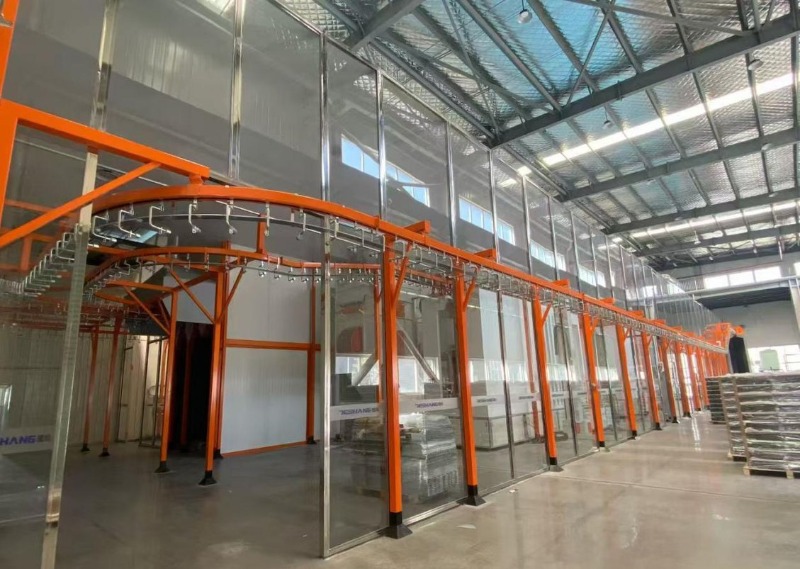
Paints and protects steel components on a continuous line. Coating is the step that decides how the frame performs in humid, coastal or corrosive air, and having it in-house means it is done to one standard.
Roof and floor assemblies are built as separate sub-assemblies before final assembly — the same logic that lets a camp be deployed quickly on site starts here.
Finished units are packed and stored, then loaded out for shipping — the point where a factory unit becomes a consignment.
At three checkpoints, each doing a different job:
Inspection at every production step, with a 100% pass rate for finished products at the final gate — a unit that fails FQC is reworked and re-inspected, not shipped.
For a buyer, the sequence matters more than the labels. IQC protects the steel that will be load-bearing for the life of the building. IPQC protects the fit, so that a panel replaced three years later still lines up. FQC protects the consignment — and because a failing unit goes back into rework instead of onto the container, the failure is absorbed by the factory rather than discovered by a site team on the other side of the world with no spare parts on hand.
Wanbang manufactures in its own production bases and does not outsource, which keeps quality control at every stage inside one system rather than split across suppliers.
The practical difference is where the responsibility sits. When a factory outsources, the incoming inspection it runs is a buyer's inspection of someone else’s work — it can reject a batch, but it cannot change how that batch was made. When the whole sequence from cutting to coating to final assembly sits on one site, the factory controls the process that produces the result, and a defect found at FQC traces back to a step it owns and can correct.
It also removes a handover. Between an outsourced stage and the next one, a unit physically moves between companies, and the specification travels with a document rather than with the process. On a camp order of several hundred identical units, that is where tolerance drift tends to enter: parts that should be interchangeable arrive from different processes and no longer line up.
The order of the last four stages answers this. Commissioning and self-inspection happen first, then IPQC, then FQC, and only then does the unit reach packing and warehousing. Packing is deliberately downstream of final inspection: nothing is wrapped, palletised or loaded until it has already passed.
The specification a unit is checked against is the one it was ordered to. The standard flat-pack and quick-assembly container house measures 6,055 mm × 2,990 mm × 2,896 mm, with a high-strength galvanized steel frame, colour-steel rock wool sandwich panel walls, a cement fibre board floor with PVC flooring and a perimeter drainage system. Wall panels are available at 50 mm and 75 mm. The folding container house unfolds to 5,900 mm × 2,500 mm × 2,470 mm, with hinges and locking fittings designed so the unit compresses to roughly one sixth of its volume for transport.
Because these are fixed specifications rather than per-order drawings, a unit inspected in one batch is built to the same dimensions as a unit inspected in the next. For a buyer ordering 300 units across two shipments, that is the difference between two identical consignments and two consignments that need on-site adjustment.
Production runs from four bases in southern China: Minqing and Qingkou in Fuzhou, Zhangzhou in Fujian Province, and Guangdong. The company was established in 2012, and the Fuzhou head office coordinates design, production, marketing and service from a single organisation.
The company states that its teams coordinate across these production bases and can be reallocated to support each other, which is how supply capacity is maintained on large orders.
Manufacturing time depends on order volume and specification rather than on a single fixed figure per unit, because units move through the line in batches rather than one at a time. The relevant question for a project schedule is usually not how long one unit takes, but how much of the order can run through the line and the three inspection gates in parallel — that is a question for the sales team on your specific quantities and delivery window.
They are the three quality-control checkpoints in the production line. IQC (Incoming Quality Control) inspects raw materials before production starts. IPQC (In-Process Quality Control) inspects units during production. FQC (Final Quality Control) inspects the finished product — a pass goes to warehouse storage, and a fail goes back for rework and repair.
No. Production is carried out in Wanbang’s own production bases rather than outsourced, which keeps quality control at every production step inside the same system as the manufacturing itself.
Yes. Packing and outbound shipping are the last stages in the sequence, and they come after both in-process inspection (IPQC) and final inspection (FQC). Units that fail final inspection are routed to rework and repair rather than being packed for shipment.
The frame is high-strength galvanized steel. Walls are colour-steel rock wool sandwich panels, available at 50 mm and 75 mm thickness, and the floor is cement fibre board with PVC flooring. The standard flat-pack container house also has a drainage system organised around the perimeter of the structure.


 IPv6 ΥΠΟΣΤΗΡΙΖΕΤΑΙ ΔΙΚΤΥΟ
Hi! Click one of our members below to chat on
 Ελληνικά
 English
 Français
 Deutsch
 Русский
 Italiano
 Español
 Português
 Türk
Türk Indonesia
 عربي
عربي


